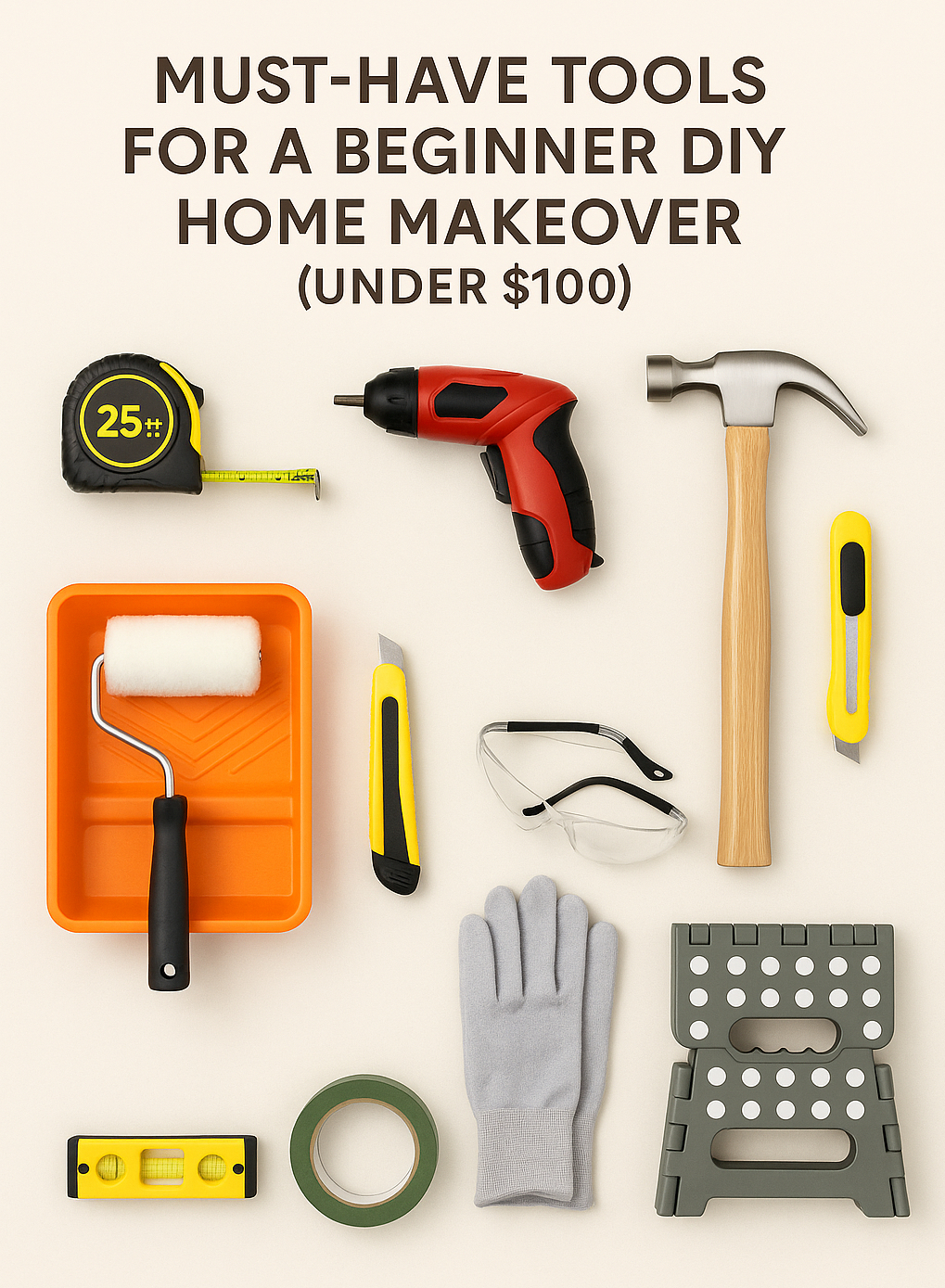
One of the first things I hear when I meet a new client is some version of: "I wouldn't even know what to buy." The tool aisle at Home Depot can feel completely overwhelming if you don't already know what you need. Everything looks official and important and expensive, and it's hard to know where to start.
Here's my honest answer: you don't need much. The most transformative home improvements — painting, patching, caulking, hanging — can all be done with a small, targeted set of tools. And you can absolutely put together that starter kit for under $100.
This is the actual list I give to every beginner I work with. Nothing extra, nothing you won't use.
"The goal isn't a full toolbox. The goal is to get started — and then grow your kit as you take on more projects."
Category 1: Painting tools
Estimated total: ~$25–30
2-inch angled brush
This is your cutting-in tool — used for painting along edges, trim, and corners where a roller won't reach. A quality angled brush makes a huge difference. I like Purdy or Wooster for beginners. Avoid the cheapest option — you'll be fighting the bristles the whole time.
~$10–15
9-inch roller + frame + tray
For any wall or ceiling painting, a roller gets the job done fast and creates that smooth, professional look. A basic 9-inch roller frame with a few roller covers (3/8" nap for smooth walls, 1/2" for textured) is all you need. Most hardware stores sell them as a starter kit.
~$12–18 for the kit
Painter's tape
Blue tape is non-negotiable. Use it to protect trim, baseboards, and any edge you don't want paint on. Remove it while the paint is still slightly wet for the cleanest edge. FrogTape is my personal favourite — it seals better than generic blue tape.
~$6–10 per roll
Category 2: Patching and prep
Estimated total: ~$10–12
Lightweight spackle + putty knife
Nail holes, small dings, and surface imperfections disappear with a tiny bit of lightweight spackle and a plastic or metal putty knife. Apply, let dry, sand smooth. That's the whole process. DAP Drydex is a beginner-friendly choice — it goes on pink and dries white, so you know exactly when it's ready.
~$6–8 for spackle, ~$4 for a basic putty knife
Sandpaper (120 and 220 grit)
For sanding patched areas smooth before painting. 120 grit for the initial pass, 220 for the final finish. A small sanding block helps keep your pressure even.
~$4–6 for a variety pack
Category 3: Measuring and hanging
Estimated total: ~$20–25
Tape measure (25 ft)
For measuring walls, furniture placement, curtain rod heights — you'll reach for this constantly. Any 25-foot tape measure works fine. I like a slightly wider blade (3/4 inch) because it stays rigid when extended, which makes solo measuring much easier.
~$8–12
Small torpedo level
For hanging art, shelves, curtain rods — anything that needs to be straight. A 9-inch torpedo level is small enough to keep in a drawer and useful for almost every project. You can also use a free level app on your iPhone if you want to start with zero investment.
~$8–15
Basic hammer
A standard 16-oz claw hammer is all you need. No need to spend a lot here — any mid-range hammer from Canadian Tire or Home Depot will outlast your first dozen projects.
~$12–18
Category 4: Caulking
Estimated total: ~$12–15
Caulking gun + painter's caulk
For sealing gaps between trim and walls, around windows, or between the wall and baseboards. A properly caulked and painted room looks finished in a way that nothing else can replicate. A basic caulking gun is inexpensive, and a tube of paintable painter's caulk is all you need to start. This is one of the first things I walk clients through — the result is immediately visible.
~$6–8 for the gun, ~$5–7 per tube of caulk
Where to buy
In Canada, I find the best value at:
- Home Depot — great selection, often has starter kit bundles
- Canadian Tire — good for brushes, tape, and basic hardware; watch for sales
- Amazon Canada — useful for comparing brands and reading reviews before you commit
- RONA or Home Hardware — if you prefer smaller stores with knowledgeable staff
Where to start if you're truly beginning
If you can only buy one category right now, start with painting tools. Paint is the single most impactful thing you can do to transform a room, and you'll use those tools on almost every project going forward. Everything else can wait until you have a specific project that calls for it.
The goal isn't to own every tool. The goal is to own the right tools for the project in front of you — and build from there as your confidence grows.
Start small. Start somewhere. The rest follows.
— Sheri Walker · South Surrey, BC